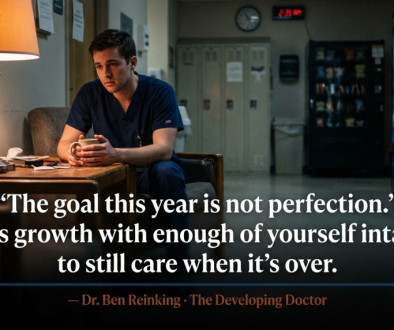

Navigating Conflicting Values in Medical Professionalism
When Duty Calls: Conflicting Personal and Professional Values
As I sat in the hospital waiting room, my mind bounced between worrying about my dad and feeling guilty about the work I was missing. My dad was undergoing a heminephrectomy, and I had taken time off to be with him and support my mom. Despite having sufficient leave and supportive colleagues, I felt like a slacker — unable to shake the feeling that I was letting people down.
The Waiting Room Wake-Up Call
Throughout the day, I caught myself compulsively checking emails and my Epic Inbasket — an unconscious habit years of training had built into me. This internal struggle between wanting to be fully present for my family and feeling a professional obligation to stay connected left me conflicted and drained.
I know I am not alone in this experience. Medical training creates an interesting paradox: we learn to be compassionate healers, yet we normalize sacrificing our personal lives for the sake of our profession. The real question is whether this trade-off actually makes us better doctors.
The direct answer: Physicians carry three overlapping value systems — personal, professional, and institutional — and these systems regularly conflict. Suppressing personal values in favor of professional ones is not just unsustainable. It generates the moral distress that drives burnout. The path forward is not choosing one set of values over the other but developing a deliberate framework for navigating the tension between them.
Understanding Our Value System
Our values largely drive behavior — the principles and beliefs that guide our decisions and actions. Most physicians hold 5–10 core values that form the foundation of their character. These stay relatively consistent throughout life, though priorities shift over time. Two of my top values are freedom and family. In my younger years, freedom ranked higher. As I have grown older, family has moved to the top of my hierarchy.
The Clash of Personal and Professional Value Systems
The conflict I felt in the waiting room arose because physicians hold multiple distinct value sets that shape behavior differently depending on context:
- Personal values (family, health, connection, joy)
- Professional values (patient care, excellence, dedication, competence)
- Institutional values (efficiency, productivity, protocol, metrics)
These overlap significantly — but not completely. The gaps between them are where conflict lives.
The Hidden Curriculum of Medical Training
Medical training instills a specific set of professional values through explicit teaching and a hidden curriculum: hard work, dedication, respect for life, patient autonomy, perfectionism, and self-sacrifice. These values combine into a physician’s mindset and create a shared professional identity that sometimes conflicts directly with personal values and needs. This ingrained mindset generated the guilt I felt while sitting with my parents during my dad’s illness.
The Burnout Connection
Medical school does not teach this, but constantly suppressing personal values for professional ones is not just unsustainable — it is dangerous. Brilliant colleagues burn out precisely because they cannot reconcile this conflict. Research confirms what most physicians experience intuitively: value misalignment drives moral distress, and chronic moral distress drives burnout. Protecting your personal values is not a luxury. It is a clinical necessity.
Living in Alignment with Your Core Values
Living in alignment with your core values produces true fulfillment — not constant professional sacrifice. Being present for my father’s surgery made me a better physician, not a worse one. It reminded me why I chose medicine: to help people during their most vulnerable moments. Honoring that same principle for my own family made the calling more vivid, not less.
When physicians feel whole and fulfilled outside of medicine, they bring their best selves to the patients who need them. These are not competing priorities — they are reinforcing ones.
Creating Your Value-Based Practice Framework
How do you align personal and professional values without compromising either? These are the six steps I used to restructure my own approach.
- Conduct Regular Value Mapping Exercises: Identify your core values — write down what truly matters to you personally and professionally. Perhaps it is family, integrity, your pets, or the pursuit of excellence. Compare the two lists to see where priorities overlap and where they diverge. This clarity guides future decisions before conflict forces them.
- Set Clear Boundaries: Designate specific times for email checks or establish an off-the-clock rule — work communications stay out of personal hours. Boundaries are not about shutting down. They reflect intentional availability rather than unlimited access as the default.
- Practice Self-Compassion: Acknowledge that prioritizing personal needs is not only normal — it recharges the capacity to give clinically. Physicians extend compassion to patients reflexively. Extending that same compassion to yourself is equally essential and significantly harder.
- Communicate Openly with Your Team: Honest dialogue with colleagues and supervisors about your values builds a supportive environment. Sharing your experiences often inspires others to do the same, creating a culture of openness and mutual respect that benefits everyone.
- Seek Support from Peers: Build a network of fellow physicians or professionals who understand the challenges of balancing personal and professional values. Support groups or mentorship programs provide valuable perspectives and coping strategies — and confirm that you are not navigating this alone.
- Align Your Career Choices with Your Values: When considering job offers or new roles, your identified values guide these choices. Seek work environments that promote well-being and prioritize balance. Sometimes a significant change in practice setting or role leads to greater fulfillment than optimizing within a poor fit.
The Transformation Through Reflection
Reflecting on my father’s illness made clear that honoring my values did not mean failing my patients. Prioritizing my family’s needs taught me something about connection and empathy that I carried back into clinical practice.
Physicians who feel whole and fulfilled outside of medicine bring their best selves to the patients who need them. The two do not compete — they sustain each other.
Sustaining Personal and Professional Values in Practice
True fulfillment comes from living in alignment with our values — not from suppressing one set to satisfy another. Striking a balance between personal happiness and professional excellence allows physicians to be compassionate healers while remaining true to themselves.
When I chose to spend that time with my family during a critical period, I realized it was not a departure from my calling. It was the essence of it. Medicine is not just about clinical expertise. It is about caring deeply for people — including the ones closest to us.
Caring for Yourself Is Caring for Others
Physicians carry a responsibility to care for both their patients and themselves. Prioritizing personal values alongside professional obligations produces greater satisfaction in work and deeper connections in personal life.
If you feel stretched thin or caught in the tension between your roles, take a moment to reflect. Identify your core values. Reassess your priorities. Have the conversations that need to happen.
Taking care of your well-being is not a personal victory separate from your clinical work — it is part of it. Honoring your values keeps you at your best for the patients who rely on you.
Ready to align your personal and professional values with structured support? Schedule a free coaching consultation with Dr. Ben Reinking to explore how physician coaching helps you build a career that honors all of who you are.
Frequently Asked Questions
Why do physicians struggle to prioritize personal values?
Medical training systematically conditions physicians to subordinate personal needs to professional obligations — through a hidden curriculum that celebrates self-sacrifice and pathologizes the appearance of limitation. By the time physicians reach practice, this conditioning operates largely below conscious awareness. Most physicians do not choose to neglect personal values. They simply follow the behavioral patterns their training deeply reinforced.
Is it possible to honor personal values without compromising patient care?
Yes — and research on physician well-being consistently supports this. Physicians who feel fulfilled personally show up to clinical work with greater empathy, lower error rates, and more sustainable performance over time. The belief that personal and professional values must compete is itself a product of medical training culture, not an empirical reality. Protecting your personal values makes you a more effective physician, not a less committed one.
How do physicians identify their core values?
The most effective approach is a structured values mapping exercise: write down 10–15 values that feel important to you, then narrow the list by asking which five you could not compromise without losing yourself. Compare your personal and professional value lists to see where they align and where they create tension. Patterns of recurring conflict — situations where you consistently feel guilty, drained, or resentful — often point directly to unacknowledged value violations.
When should a physician consider coaching for values alignment?
When the conflict between personal and professional values has become chronic rather than situational — when guilt, resentment, or exhaustion have become the baseline rather than temporary responses to specific demands. Coaching provides a structured, confidential space to map your values, understand where your current work honors or violates them, and develop concrete strategies for greater alignment without abandoning professional commitment.
About the Author Dr. Ben Reinking is a practicing pediatric cardiologist, certified physician coach, and founder of The Developing Doctor. He writes about the intersection of physician identity, values, and well-being — drawing on nearly two decades of clinical practice and his own experience navigating the tension between professional demands and personal life. Learn more at thedevelopingdoctor.com.