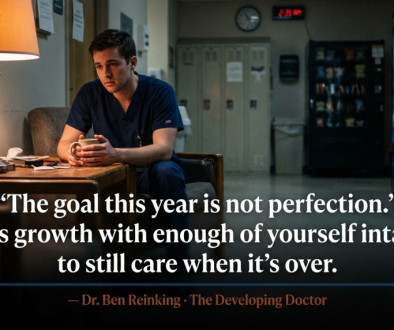

Core Values of Physicians: Defining the Essence of Medicine
Why did you decide to become a doctor? Was it to help others, to challenge yourself, to make a living — or some combination of all three? If you are like most physicians I know, the answer is layered and deeply personal.
Now pause and ask yourself a harder question: why do you hold the position you currently hold? Why do you get out of bed every morning?
When was the last time you thought seriously about what is truly important to you? As physicians, we face a relentless mix of responsibilities, expectations, and competing pressures. Amidst the growing epidemic of burnout and career dissatisfaction in medicine, this question is not academic. It is urgent.
The core issue: Misalignment between what we believe in and what we actually do each day is one of the primary drivers of physician dissatisfaction, moral injury, and burnout. Reconnecting with your core values — and building your work life around them — is not a soft exercise. It is one of the most practical things a physician can do to sustain a long, meaningful career.
What Are Core Values?
Core values are the fundamental beliefs and principles that guide behavior, decision-making, and how a person engages with the world. They function as an internal compass — shaping your actions, attitudes, and interactions even when no one is watching.
For physicians, core values commonly include:
- Compassion — genuinely caring for patients and their well-being
- Integrity — maintaining honesty and ethical standards in all professional interactions
- Excellence — pursuing the highest quality of care and continuous improvement
- Respect — treating all patients, colleagues, and staff with dignity
- Empathy — understanding and sharing the feelings of patients and their families
- Lifelong learning — committing to ongoing education and staying current with medical knowledge
- Patient-centeredness — prioritizing the needs and preferences of patients in care decisions
- Collaboration — working effectively with interdisciplinary teams for optimal outcomes
- Accountability — taking responsibility for one’s actions and decisions in patient care
- Work-life balance — valuing personal well-being alongside professional performance
These values are deeply personal. They are shaped by life experience, cultural background, education, and the specifics of your training. Living in alignment with your core values is essential for both personal fulfillment and professional sustainability — particularly for physicians navigating daily ethical complexity.
Values Exist at Multiple Levels — and They Often Conflict
Understanding why values misalignment is so common in medicine requires recognizing that values operate at several distinct levels simultaneously:
Personal values are the individual beliefs and principles that define your character — compassion, integrity, lifelong learning, and the commitments that feel most fundamentally you.
Professional values are the standards and ethics specific to medicine. The Hippocratic Oath articulates many of them: patient-centeredness, evidence-based practice, integrity, service, and confidentiality.
Societal values are the broader cultural norms that shape how we interact as communities — respect for human rights, equity, and social responsibility.
Organizational values are the principles that guide institutional decision-making — innovation, teamwork, financial sustainability, and throughput targets.
Because every person and every institution is unique, conflict between these levels is inevitable. A physician who deeply values patient connection may find their organizational culture relentlessly pushing for shorter visits. One who values integrity may face systemic pressures toward documentation practices that feel ethically uncomfortable. This conflict — between what you believe and what your environment demands — is what we call value misalignment.
How Value Misalignment Impacts Physicians
When physicians repeatedly make decisions that conflict with their core values, the consequences accumulate. Research consistently links value misalignment to moral injury, burnout, and career dissatisfaction. In practice, it often shows up as:
- Reduced quality of patient care driven by disengagement and emotional exhaustion
- Increased risk of ethical lapses or medical errors
- Strained relationships with colleagues, staff, and patients
- Persistent cynicism and a growing sense that medicine is no longer meaningful
- High turnover and early retirement
Value misalignment is not a character flaw. It is a structural problem — and like most structural problems, it responds to deliberate intervention.
Three Exercises to Realign Your Values and Your Work
Exercise 1: Values Clarification
- Set aside 20 uninterrupted minutes and reflect on your personal and professional values.
- Write them down without filtering or ranking — get them all on paper first.
- Once you have a full list, identify your top five and rank them in order of importance.
- Compare your list to your organization’s stated values. Where do they align? Where do they conflict? Name the gaps explicitly.
This exercise does not solve the problem immediately — but naming the gap is the essential first step toward closing it.
Exercise 2: Decision-Making Audit
- Identify three to five significant decisions you have made at work in the past few months.
- For each decision, ask: did this choice reflect my core values? If not, what drove it instead?
- Look for patterns. Are there specific contexts — particular relationships, institutional pressures, time constraints — where your values consistently get overridden?
The goal is not guilt. It is pattern recognition. Understanding where and why your values get squeezed gives you the information you need to advocate for different conditions.
Exercise 3: Values-Based Goal Setting
Set one professional goal that explicitly expresses a core value. If lifelong learning is central to who you are, commit to one conference, certification, or structured learning experience in the next six months. If connection is a top value, redesign one part of your schedule to protect time for meaningful patient interaction.
Small, values-aligned goals build momentum. They remind you — week by week — that you have more agency than the system sometimes makes it feel.
The Bigger Picture
By consciously aligning your actions with your core values, you can meaningfully improve your professional satisfaction, the quality of care you provide, and your longevity in medicine. This is not just about personal fulfillment — though it matters deeply. It is about being the physician your patients need and the colleague your team deserves.
If you are feeling unfulfilled or burned out, values misalignment is often a significant part of the story. And it is one of the most addressable parts, with the right support.
Ready to do the deeper work of values clarification and career realignment? Schedule a free 30-minute discovery call with Dr. Ben Reinking to explore whether physician coaching is the right next step for you.
Frequently Asked Questions
What are the core values of a physician? Physician core values are the fundamental beliefs that guide clinical practice and professional behavior. Common examples include compassion, integrity, patient-centeredness, accountability, lifelong learning, and respect for human dignity. These values vary by individual and are shaped by personal experience, cultural background, and training. The Hippocratic tradition provides a shared professional foundation, but how values are lived out in daily practice is deeply personal.
What is value misalignment in medicine? Value misalignment occurs when a physician’s personal or professional values consistently conflict with the demands of their work environment. For example, a physician who values deep patient connection but works in a system optimized for high-volume throughput will experience misalignment daily. Over time, this gap drives moral injury, burnout, and career dissatisfaction.
How does value misalignment contribute to physician burnout? Burnout in physicians is not simply the result of long hours — it is frequently driven by the chronic experience of being asked to act in ways that contradict deeply held beliefs. When the work you do every day conflicts with why you entered medicine, the resulting moral and emotional friction is exhausting in a way that rest alone cannot repair. Addressing value misalignment is often a necessary part of genuine burnout recovery.
How can a physician identify their core values? Start with reflection: think about the moments in your career when you felt most alive and engaged, and contrast them with the moments of deepest depletion. The patterns reveal your values. Structured exercises — like the Values Clarification and Decision-Making Audit described above — provide a more systematic approach. Working with a coach can accelerate this process significantly.
Can realigning your values actually change your experience of medicine? Yes — often dramatically. Most physicians who feel stuck or burned out are not fundamentally unsuited to medicine. They are practicing medicine in a way that does not honor what brought them to it. Values-aligned coaching and career design does not require leaving medicine. It requires understanding what you need your work to provide — and then building intentionally toward that.
About the Author Dr. Ben Reinking is a practicing pediatric cardiologist, certified physician coach, and founder of The Developing Doctor. With nearly two decades of clinical experience and leadership roles as fellowship director and division director at the University of Iowa, Ben helps physicians reconnect with their values, navigate burnout, and build careers that are both excellent and sustainable. Learn more at thedevelopingdoctor.com.