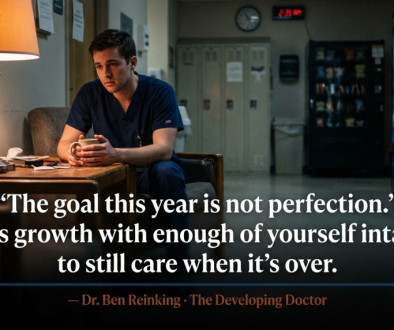

The Physician’s Burden: How the Physician Mindset Can Make or Break Your Career
Picture this: you are in the operating room, and a critical error occurs. The patient’s life hangs in the balance, and the weight of the world seems to rest on your shoulders. In that moment, do you take ownership of the mistake, try to conceal it, or place the blame on others?
As a physician, you know that no one in medicine works in a silo. All successes and missteps result from the actions of a team. Yet this fact is frequently forgotten — or simply overridden by a deeper, more visceral sense of personal responsibility. Even if you logically understand that outcomes do not rest solely on your shoulders, you feel physically, mentally, and emotionally responsible for them. This overwhelming sense of responsibility is a direct result of the mindset developed during medical training — a mindset that can either propel you toward greatness or drive you toward burnout and a diminished career.
The direct answer: Medical training systematically instills a performance-oriented, fixed mindset in physicians — one that prioritizes appearing competent over learning from mistakes. This “physician mindset” was adaptive during training but becomes a liability in practice, contributing to burnout, defensiveness, and an inability to grow. The antidote is a growth mindset: the evidence-based belief that abilities develop through effort and reflection, and that challenges and errors are data, not verdicts.
The Physician Mindset: What It Is and How It Forms
Medical training is rigorous and demanding. Premeds, medical students, residents, fellows, and practicing physicians are all held to extremely high standards throughout their formation. The result is highly skilled clinicians — but also professionals with deeply embedded performance-oriented, fixed mindsets.
The constant pressure to be perfect, combined with the fear of making potentially life-altering mistakes, trains physicians to prioritize appearing competent over asking for help and learning from failure. This is the physician mindset: the implicit belief that uncertainty must be hidden, that mistakes reflect personal deficiency, and that having the right answer is more important than being genuinely curious about the question.
The physician mindset limits doctors’ ability to adapt, ask for help, and embrace new challenges. In training, this was partly functional. In practice — over a career — it becomes a source of burnout, defensiveness, and stagnation.
Growth Mindset vs. Physician Mindset: Understanding the Difference
A growth mindset, as defined by psychologist Carol Dweck, is the belief that abilities and intelligence can be developed through effort, learning, and persistence. People with a growth mindset view challenges as opportunities to improve and failures as stepping stones to mastery. Research from the AAMC and others consistently links growth mindset to better learning outcomes, resilience, and professional sustainability.
The physician mindset, shaped by medical training culture, tends to align more closely with a fixed mindset. It leads physicians to view their abilities as largely static, and to fear that admitting uncertainty or acknowledging errors will undermine their professional credibility.
The key differences:
- Approach to challenges: The growth mindset embraces challenges as opportunities for development; the physician mindset avoids them to preserve the appearance of competence.
- Response to failure: The growth mindset treats failure as a learning opportunity; the physician mindset treats it as a threat to professional standing.
- Effort and improvement: The growth mindset values deliberate effort as the path to mastery; the physician mindset emphasizes appearing to have innate talent and quick, correct answers.
- Feedback reception: The growth mindset welcomes constructive criticism; the physician mindset tends to be defensive and experience feedback as an attack.
Developing a Growth Mindset
The medical system has real, systemic problems — and the physician mindset does not explain or excuse any of them. Changing your mindset will not fix what is broken at the system level. But a new mindset will change your ability to function within that system — to adapt, advocate, and build a more sustainable career despite its imperfections. Once your mindset changes, your experience of the same environment changes with it.
Three exercises that help cultivate a growth mindset in practice:
- Daily Reflection Journal: Spend five minutes each evening writing about one challenge you faced during the day. Rather than focusing on the outcome, reflect on what you learned from the experience and how you might apply that knowledge going forward. This habit builds self-awareness and reframes difficulty as productive rather than threatening.
- “Yet” Practice: When you encounter a limitation or shortcoming, add the word “yet” to your self-talk. Change “I do not understand this procedure” to “I do not understand this procedure yet.” This small linguistic shift acknowledges that growth is possible — and possible specifically for you — in ways that static self-assessments do not.
- Skill-Building Challenge: Choose a new skill unrelated to your medical practice — learning a language, playing an instrument, developing a craft — and practice it for 15 minutes daily for one month. This exercise reinforces at a felt level that abilities develop through sustained effort, and makes the growth process concrete and personal rather than abstract.
The Bigger Picture
In conclusion, the growth mindset is one of the most practical tools available to physicians navigating the demands of modern medicine. By embracing the belief that intelligence and abilities are malleable — not fixed at the end of training — physicians can approach their work with curiosity, resilience, and genuine adaptability.
This mindset shift matters for individual physicians. It also matters for medical education. Educator who foster growth mindset cultures in training programs, create environments where trainees take appropriate risks, learn openly from errors, and develop the capacities that competent, compassionate clinical care actually requires.
The adoption of a growth mindset is not just about individual success. It is about building a healthcare culture that prioritizes genuine learning, honest collaboration, and patient-centered care across the full arc of a physician’s career.
Ready to shift from a fixed physician mindset to a growth mindset — with structured support?Schedule a free coaching consultation with Dr. Ben Reinking to explore how physician coaching accelerates this transformation.
Frequently Asked Questions
What is the physician mindset?
The physician mindset is the performance-oriented, fixed mindset that medical training systematically cultivates. It is characterized by a deep need to appear competent at all times. In addition, avoidance of uncertainty or mistakes, defensiveness in response to feedback, and a tendency to treat setbacks as threats to professional identity rather than as learning opportunities are common. While adaptive during the high-stakes evaluation periods of training, it becomes a significant liability over the course of a career.
How does the physician mindset contribute to burnout?
The physician mindset contributes to burnout through several mechanisms. First, it prevents physicians from asking for help early, which allows problems to compound. Second, it creates constant emotional vigilance around appearing competent, which is exhausting over time. Third, it makes feedback feel threatening rather than useful, which closes off an important growth channel. Finally, it leaves physicians isolated in their difficulties an unable to normalize vulnerability with colleagues. All of these patterns directly accelerate emotional exhaustion.
Can a physician change their mindset after training?
Yes — and research on growth mindset consistently supports this. Mindsets are not fixed traits; they are habitual ways of interpreting experience that can be deliberately shifted through sustained practice. The three exercises described in this post — reflection journaling, “yet” practice, and skill-building challenges — are all evidence-supported tools for this kind of change. Physician coaching significantly accelerates the process.
What is Carol Dweck’s growth mindset and how does it apply to medicine?
Carol Dweck, a psychologist at Stanford, developed the concept of growth mindset through decades of research on achievement and learning. A growth mindset is the belief that abilities and intelligence are not fixed. Rather, abilities can be developed through effort, deliberate practice, and willingness to learn from setbacks. In medicine, applying this framework means treating clinical challenges as learning opportunities. It means approaching feedback as useful data rather than personal criticism. Finally, the best physicians are not the ones who started with the most talent. The best physicians grow throughout their careers.
About the Author Dr. Ben Reinking is a practicing pediatric cardiologist, certified physician coach, and founder of The Developing Doctor. He writes about the mindset patterns that medical training instills. This includes those that help and those that quietly harm. Discover how physicians can develop the self-awareness and adaptive capacity to build long, sustainable careers in medicine. Learn more at thedevelopingdoctor.com.
Updated April 2026