Burnout and Healthcare System Transformation: A Human Vision
Series: Part 1 | Part 2: Provider Solutions | Part 3: Patient Approaches
Editor’s note: This post is the first in a three-part series examining the burnout crisis in U.S. health care and outlining a blueprint for system transformation. Part 2 explores what providers need to thrive, and Part 3 examines how to build programs that put patients at the center while sustaining financial viability.
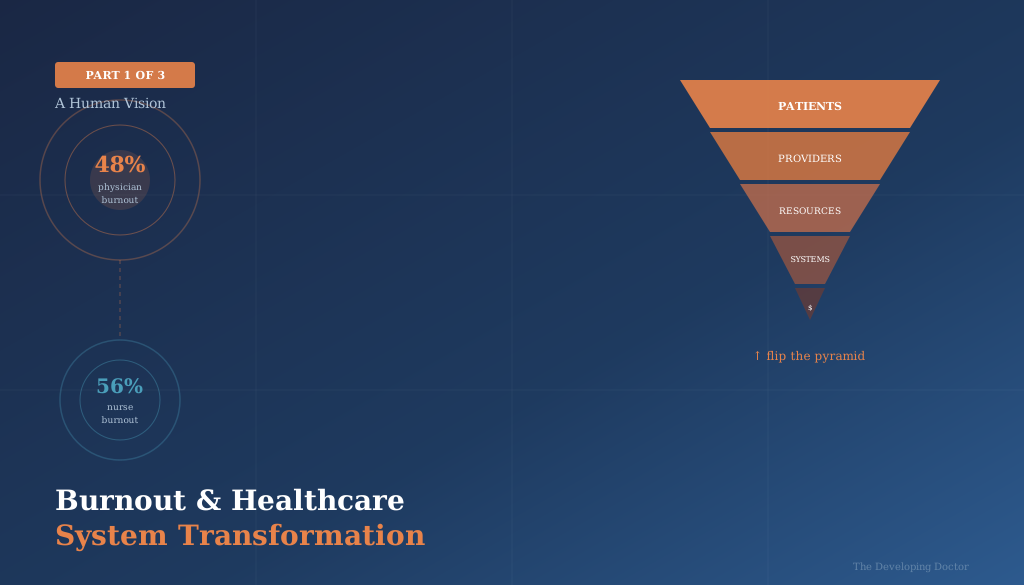
The direct answer: Physician and nurse burnout is not a resilience problem. It is a systems problem — the predictable result of a healthcare architecture that places profitability above patients and providers. Meaningful transformation requires flipping that priority pyramid: patients first, providers second, resources third, systems fourth, and financial sustainability last (but not ignored). This post explains why the current order fails, and what a patient-centered redesign looks like in practice.
The Burnout Crisis: Physicians, Nurses, and Leaders
Burnout is not an individual failure. It is a symptom of a misaligned healthcare system. Data show that 48.2% of physicians reported at least one symptom of burnout in 2023, down from 53% in 2022 but still alarmingly high. Nurses are faring even worse: the American Nurses Foundation’s 2023 survey found that 56% of nurses experience burnout and 64% feel “a great deal” of job-related stress. The problem reaches the boardroom as well — roughly one-third of healthcare executives and managers score in the high burnout range. In large health systems such as the Veterans Health Administration, self-reported burnout climbed from 30.4% in 2018 to 39.8% in 2022 and eased slightly to 35.4% in 2023.
This widespread exhaustion does not reflect a shortage of resilience or wellness classes. It reflects the demands of a system that values documentation, billing, and throughput over people. When half the clinical workforce feels depleted, patient safety and organizational sustainability are both at risk.
Systemic Inefficiencies and Poor Outcomes
The United States spends more on healthcare than any other nation. National health expenditures grew 7.2% to $5.3 trillion in 2024, totaling about $15,474 per person and accounting for 18% of gross domestic product. Yet the return on that investment is poor. Americans spend nearly twice as much per capita on healthcare as their peers in other wealthy nations, yet the U.S. has lower life expectancy and performs worse on many long-term health outcomes.
Access to care is also problematic. About one in five young and middle-aged adults reports non-cost-related barriers such as lack of appointment availability and difficulty finding a provider. Fifty-three percent of the U.S. population lives in areas designated as having an insufficient supply of primary care providers — which is why 16% of adults seek care in the emergency department for issues that could have been managed in a clinic.
Even outside the health system, Americans are not healthy. Three-quarters of adults live with at least one chronic condition and more than half have two or more. Obesity affects more than two in five adults, contributing to diabetes, heart disease, and other chronic illnesses. Our fragmented system struggles to prevent disease, coordinate care, or address social determinants of health — despite the enormous resources devoted to it.
Reimagining the System: A Patient-Centered Blueprint
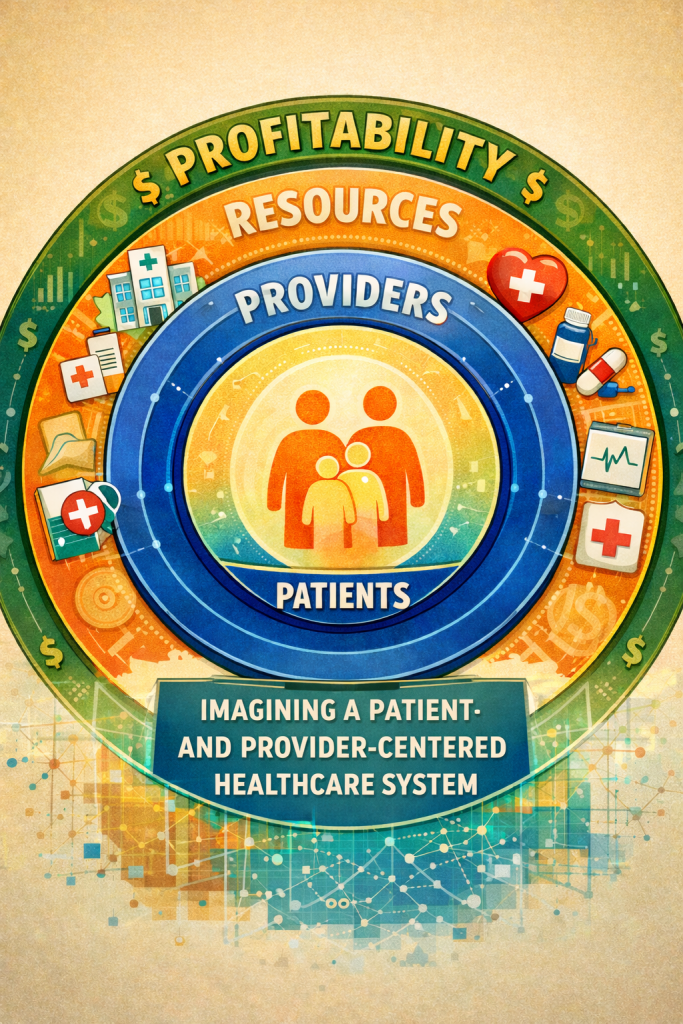
Today’s healthcare system optimizes for profits first, reputation second, physical capital third, patients fourth, and personnel last. Flipping this pyramid means putting patients at the top. A patient-centered design asks:
- What do patients need? Map how people enter, move through, and exit the healthcare system. Design processes for timely appointments, seamless transitions between services, and support when patients are at home.
- How can providers meet those needs? Empower clinicians to operate at the top of their license by removing unnecessary administrative burdens and clarifying expectations. Build flexibility into schedules so providers can work safely, efficiently, and joyfully.
- What resources are essential? Invest in spaces, equipment, and technology that support patient-centered workflows instead of dictating them. Allocate resources based on patient needs and provider workflows rather than prestige projects.
- What system architecture will support patient and provider? Align payment models, data systems, and governance structures around quality, access, and continuity. Incentivize prevention and population health instead of volume.
- How can this be sustainable? Profitability should flow from delivering high-value care. When patients receive effective, timely care and clinicians are supported, waste decreases and margins improve.
Example: Designing a New Program
Consider a clinic planning a diabetes management program. Under the traditional model, administrators start by budgeting for equipment and staff, then figure out how to attract patients. A patient-centered approach begins by understanding the community’s needs: Who is at risk? How can they be reached? What barriers prevent regular visits?
Such a program might offer flexible appointment times, telemedicine visits, culturally tailored education, and coordination with community organizations. Providers would have clear expectations and the flexibility to manage their panels. Technology and space would support team-based care rather than isolate clinicians in front of computers. The financial plan would tie to outcomes like reduced hospitalizations and improved glycemic control, ensuring sustainability.
Looking Ahead
Burnout reflects a system out of balance. By reordering priorities — patients first, providers second, resources third, systems fourth, and profits last — we can create a healthcare system that delivers better outcomes and fosters joy in practice.
Part 2 of this series explores what providers need to thrive and how leadership can support them: Provider-Oriented Solutions: Building a Better Workplace for Clinicians.
For the individual physician navigating burnout within the current system, start here: Physician Burnout, Moral Injury & Ordinary Joy.
For career growth and leadership within a changing system: Physician Leadership & Mentorship.
Frequently Asked Questions
Is physician burnout primarily a systemic problem or an individual one?
Systemic — and the data are clear on this. When nearly half of all physicians and more than half of all nurses report burnout symptoms simultaneously, that is not a coincidence of individual weakness. It is the predictable result of a system that chronically demands more than it provides in return: excessive documentation, productivity quotas, shrinking autonomy, and an organizational culture that treats self-sacrifice as a professional virtue. Individual strategies like mindfulness and wellness programs provide temporary relief but do not address root causes.
Why does the U.S. spend more on healthcare but get worse outcomes?
The U.S. healthcare system optimizes for volume and billing rather than health outcomes and prevention. Fee-for-service payment models reward procedures over prevention. Fragmented care prevents coordinated management of chronic conditions. High administrative costs — estimated at roughly 34% of total healthcare spending — divert resources from direct care. Social determinants of health (food access, housing, transportation) receive little systemic attention despite their outsized impact on outcomes.
What does a patient-centered healthcare system look like in practice?
A patient-centered system begins by mapping what patients actually need, then designs workflows, staffing, technology, and financial models to meet those needs — rather than starting with the budget and fitting patients in afterward. In practice, it means flexible scheduling, care coordination across settings, culturally tailored communication, team-based care where every clinician works at the top of their license, and payment models tied to outcomes rather than volume.
About the Author Dr. Ben Reinking is a practicing pediatric cardiologist, certified physician coach, and founder of The Developing Doctor. He writes about the healthcare system’s structural problems and the individual, organizational, and systemic solutions that can restore sustainability and joy to medical practice. Learn more at thedevelopingdoctor.com.
References
- American Medical Association. Physician burnout rate drops below 50% for the first time in 4 years. https://www.ama-assn.org/practice-management/physician-health/physician-burnout-rate-drops-below-50-first-time-4-years
- American Nurses Foundation. National nursing workforce survey: burnout and stress findings. https://www.nursingworld.org/news/news-releases/2023/the-american-nurses-foundation-says-action-is-still-needed-to-address-serious-nursing-workforce-challenges/
- Centers for Medicare & Medicaid Services. National Health Expenditure Fact Sheet. https://www.cms.gov/data-research/statistics-trends-and-reports/national-health-expenditure-data/nhe-fact-sheet
- Peterson-KFF Health System Tracker. How does the quality of the U.S. health system compare to other countries? https://www.healthsystemtracker.org/chart-collection/quality-u-s-healthcare-system-compare-countries/
- Centers for Disease Control and Prevention. About Chronic Diseases. https://www.cdc.gov/chronic-disease/about/index.html
- Centers for Disease Control and Prevention. Adult Obesity Facts. https://www.cdc.gov/obesity/adult-obesity-facts/index.html