
Physician Signature Strengths: The Burnout Intervention You Weren’t Trained In
When I started medical school, the curriculum had just shifted to small-group case discussion. Six to ten students sat around a table every week. A faculty member graded our participation.
I dreaded it.
I am naturally introspective. Generally, I think before I speak, and I process internally before I respond externally. In a room that measured contribution by airtime, that worked against me.
Every evaluation came back the same. Needs to speak up more. Sometimes that was the only feedback I received. No mention of what I was doing well. No acknowledgment that contribution might look different from one student to the next.
So I did what most physicians learn to do under critique. I focused entirely on the weakness. I worried more about my talking-to-listening ratio than I did about the case. Mistakenly, I started answering questions other people were already answering. It went poorly.
In my second year, a faculty facilitator did something different. He did not tell me to speak more. He asked a different question.
What do you think you bring to the group?
I told him I volunteered to take notes. When I did speak, my comments connected directly to the case. I encouraged classmates when they presented.
He nodded.
Then contribute by leaning into what comes naturally.
That advice changed how I performed in small groups. It also changed, eventually, how I think about burnout, fulfillment, and the work I now do with physicians at career inflection points. Because medical training trains us in the opposite direction. And over years, the opposite is exhausting.
Medical training is deficit-focused. Turning that lens inward has a cost.
Medicine teaches you to find what is wrong. Identify the lesion. Spot the risk. Catch the omission. Pre-round on the abnormal vital. That mindset keeps patients safe.
It also becomes the default lens you turn on yourself.
Physicians become experts at self-correction while gradually losing track of what energizes them. Over time, the internal monologue narrows to a single question. What am I doing wrong?
The questions that used to matter quietly stop being asked.
- What am I naturally good at?
- What gives me energy?
- What do I bring to my team that no one else does?
The shift sounds small. It is not. Burnout is rarely a sleep or hobby problem. It usually develops when your daily work becomes disconnected from your strengths, your values, and your sense of meaning. (Discover more resources in our Burnout, moral injury, and ordinary joy cornerstone post)
The reverse is also true. Reconnecting with who you are, does not require a career overhaul. Sometimes it starts with a question your second-year self stopped asking.
Stop running yourself like a quality-improvement project
The first step is noticing how much of your identity has organized itself around correction.
Physicians are trained to believe improvement comes from fixing deficiencies. There is a place for growth and remediation. The evidence is also clear that leveraging strengths produces faster, more sustainable change than grinding on weaknesses alone.
This matters more when you are depleted. Burnout narrows perspective. When reserves are low, every signal gets read through the lens of inadequacy.
- I should be more productive.
- I should be more resilient.
- I should handle stress better.
- I should not feel this tired.
“Should” rarely creates energy. It creates shame.
Before you can reconnect with your strengths, you have to stop treating yourself like a permanent improvement project.
Skills are not strengths
Most physicians confuse the two. They are not the same.
Skills are developed. Taking a history. Reading an ECG. Running a code. Charting efficiently. Presenting at M&M without flinching. You built those through training and repetition.
Character strengths are different. They are the traits that feel natural to you. Positive psychology research has mapped 24 universal character strengths shared across cultures.
Examples include curiosity, kindness, leadership, humor, perspective, perseverance, creativity, and appreciation of beauty.
Most physicians lean on four or five signature strengths without ever naming them. The problem is that medical training quietly rewards a narrow band. Perfectionism. Achievement. Self-sacrifice. Endurance. Other strengths get pushed to the background.
You can become highly skilled and deeply disconnected from yourself at the same time. Most physicians I work with arrive in exactly that state.
Notice when you feel most like yourself
One of the simplest coaching questions is this. When do you feel most like yourself at work?
Not most productive. Not most impressive. Most like yourself.
The answer almost always points at a strength. For some physicians it is teaching. For others, it is problem-solving, advocacy, comforting an anxious family, leading a team through a hard case, simplifying a complex diagnosis for a learner, or building a workflow no one else has time to build.
These moments matter because they replenish you instead of only draining you.
During my own burnout recovery, one of my coaching assignments was simple to the point of feeling absurd. I was relying almost entirely on perseverance to push myself through the week. My coach pointed out that one of my signature strengths was appreciation of beauty and excellence.
I laughed when I saw it in my results.
She asked when I had last actually noticed the world I was walking through.
I did not have a good answer.
The assignment became noticing two beautiful things on my walk into the hospital and two more on the way out. That small exercise was one of the first meaningful steps in my recovery.
Strengths are not abstract personality concepts. They are sources of energy.
Apply one strength to one draining task
You do not have to redesign your career tomorrow. Start smaller.
Pick one draining part of your job. Then ask a different question. How could I approach this through one of my strengths?
| Draining task | A strength to bring |
|---|---|
| Charting and inbox | Creativity — templates, dictation, workflow design |
| Team conflict | Perspective, fairness, or kindness |
| Teaching rounds | Humor or curiosity |
| Difficult family meetings | Social intelligence and judgment |
| Administrative work | Leadership and systems thinking |
| A repeating case type | Love of learning |
This sounds simple. It changes the underlying question you are asking.
Instead of how do I survive this? you start asking how do I bring more of myself into this?
Protect the 20% that feels meaningful
One physician well-being statistic is worth committing to memory. Physicians who spend at least 20% of their time doing work aligned with their values report meaningfully lower burnout.
That is not most of your week. It is roughly one day out of five. Some weeks, a few protected hours.
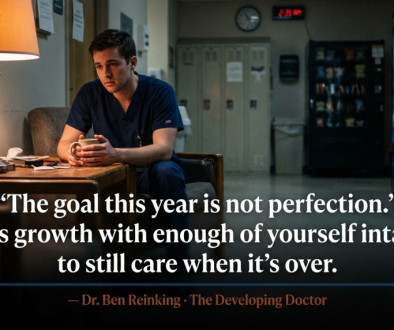
Your goal is not perfection. Your goal is enough meaningful work to stay connected to yourself. That might mean teaching more. Mentoring a fellow. Building a niche clinic. Writing. Leading a QI project. Advocacy. Coaching.
Sometimes burnout is not a signal that you need to leave medicine. Sometimes it is a signal that too little of your actual self is showing up inside it.
A simple exercise to start this week
Take out a sheet of paper. Write three short lists.
- Three tasks that drain you.
- Three moments at work that energize you.
- Three qualities people consistently appreciate about you.
Look for the overlap. The overlap usually points at a signature strength.
That is the work of the Identify phase — getting specific about what is actually wrong, what you actually want, and what you are actually good at. Most physicians arrive at this work able to describe the symptom and unable to name the pattern. The list above is the smallest legitimate way to start.
Frequently asked questions
What is the difference between a physician’s signature strength and a skill?
Skills are learned and built through repetition. Strengths are traits that come naturally and energize you when you use them. A physician can be highly skilled at a task and still find it depleting, usually because the task does not draw on their signature strengths.
How do I identify my signature strengths?
The VIA Character Strengths Survey is the most widely used free assessment and the one used inside The Developing Doctor coaching programs. It identifies your top five strengths from a list of 24. Most physicians find at least one strength on the list that surprises them, and that surprise is often the most useful data point.
Can leaning into signature strengths actually reduce physician burnout?
It will not fix a structurally broken job. But research consistently shows that physicians who spend at least 20% of their time on work aligned with their values and strengths report meaningfully lower burnout. The intervention is structural, not aspirational. It changes what your week is made of, not how hard you try.
Where do signature strengths fit inside The Developing Doctor framework?
Strengths work sits between the Identify phase and the Align phase of the four-phase operating system. Identify clarifies what is actually wrong. Align tests that clarity against what you naturally bring. Strengths are the bridge.
The next move
Most physicians can name what drains them. Far fewer can name what restores them.
Strengths are part of that answer. Values are the other part. You can know your top five strengths and still not know which ones to build your week around. That is a values question.
The Physician Values Clarity Worksheet is the tool I use with coaching clients to surface the three values that should be running every decision. Twenty minutes, on paper. Most physicians find that one of their top three is the value their current week is starving.
Download the Physician Values Clarity Worksheet →
If you want the deeper framework behind this piece, the four-phase Identify · Align · Develop · Sustain operating system, start with The Developing Doctor Operating System.