
Before Burnout Arrives: What to Build in Your First Year of Residency
I showed up to my first overnight call in a tie, a dress shirt, and khakis.
The chief resident took one look at me and laughed. “Put on scrubs,” she said. “You’re going to be more comfortable.” She was right about the scrubs. She was also right, in ways I wouldn’t understand for months, about everything else that was coming.
That night I covered a service of 30 to 40 patients I had never met. My first page sent me to a patient with mild hepatic dysfunction, an NG tube, and a nosebleed that wouldn’t stop. I panicked. Nothing in my training had prepared me for that specific combination. I did what anyone would do: applied pressure and called my senior. The next page brought a new patient with a fever and a white count that pointed toward acute lymphoblastic leukemia. After that, an infant with a fever who needed a lumbar puncture. My first LP. Ever. Supervised by my senior, guided more by instinct and eye-hand coordination than anything I had learned from a textbook.
I did not sleep that night. I’m not sure I slept much for the entire first year.
I completed residency before work hour restrictions existed. We were on call every fourth night for a full year. No panel size limits. No protected time. My laundry went from folded and organized to washed and dumped in a pile on the closet floor. Folding clothes was more than I could accomplish. My cupboards were empty. I lived mostly off the hospital meal stipend, occasional fast food on the drive home, and the canned tuna and ramen noodles I had relied on since college. When family visited from the Midwest in January — Arizona was an easy sell in winter — they would look at my kitchen and ask, “Don’t you eat?” I wanted to say, “I don’t really sleep or come home either.” That felt like too much truth for a family dinner.
Here is what I know now that I did not know then: burnout does not start in year three. It starts in the first weeks of residency, in the small decisions that feel inconsequential in the moment. What you build early — or fail to build — shapes everything that follows.
This post is what I would tell myself on that first call night. It is what I would tell every resident starting this July.
For the full framework on burnout and what it actually is: Physician Burnout, Moral Injury & Ordinary Joy.
Burnout Doesn’t Wait for You to Be Ready
Most residents think burnout is something that happens later. After the hard years. Or after the exhaustion has a chance to accumulate.
The research says otherwise. A 2023 meta-analysis in Academic Medicine found that burnout symptoms appear as early as the first month of residency. Emotional exhaustion begins before clinical competence has a chance to build. The gap between what training demands and what residents have the tools to manage is widest at the very beginning.
This matters for one important reason: prevention works better than recovery. The habits you build in the first 90 days of residency will either protect you or deplete you across the entire arc of your training. Most residents never get the chance to choose deliberately. They simply survive. Then they wonder, years later, why they feel so hollow.
You can make different choices. Not easier ones — different ones. Here is where to start.
Three Things to Build Before Burnout Arrives
1. Permission to Survive Differently
The first and most important shift is cognitive. Give yourself permission to redefine what functioning looks like this year.
My laundry lived in a pile on the closet floor. My cupboards were empty. I ate ramen and canned tuna. By any pre-residency standard, I was failing at basic adult self-care. By residency standards, I was surviving — and that was the right measure for that season.
This is not an excuse for neglect. It is an invitation to triage deliberately. Residency will take more than you expect. The question is not whether to sacrifice something. It is which things to sacrifice and which to protect at all costs.
Sleep is not optional. Food is not optional. One relationship — a partner, a friend, a family member who understands — is not optional. Everything else is negotiable.
Research on resident performance consistently shows that sleep deprivation impairs clinical judgment more than almost any other single variable. Protecting sleep is not a personal preference. It is a patient safety decision. When you are post-call, sleep. Not email. Not charting unless truly required. Sleep.
The residents who build this permission structure early fare better than those who maintain pre-residency standards until they break. Accept that this year will look strange from the outside. Stop apologizing for it.
Related: Rediscovering Joy After Physician Burnout
2. The Habit of Pivoting and Asking
My first call night taught me something no textbook could: clinical competence is not the same as clinical readiness.
I knew what to do when an infant presented with a fever. That was in the text books. I had no idea what to do when a patient with hepatic dysfunction had a mechanical nosebleed. That is not a knowledge gap. It is the gap between knowing and doing — between the controlled environment of medical school and the genuine uncertainty of real practice.
What closed that gap was not studying harder. It was learning to pivot quickly and ask without shame.
Calling my senior that first night was the right call. Senior residents and attendings carry context, experience, and judgment that no amount of reading can replicate. The residents who struggle most in early training are often the ones who wait too long to call. They confuse asking for help with admitting failure.
It is not failure. It is how medicine actually works.
Build this habit early: when something feels outside your training, name it out loud, make your best clinical decision, and call your senior. Do not wait until you are certain something is wrong. Uncertainty is the signal. Act on it.
The imposter syndrome that tells you asking will reveal your inadequacy is lying to you. Every senior resident and attending in that hospital has made that same call. They respect the resident who reaches out. They worry about the one who doesn’t.
3. One Non-Negotiable Boundary — Protected From Day One
This is the habit most residents skip. It is also the one with the most evidence behind it.
A boundary in early residency does not mean leaving on time or refusing extra shifts. Those are not realistic asks for an intern. A boundary means one protected recovery practice — one thing that belongs to you and not to the hospital.
Pick one. Protect it.
Options include a 30-minute walk after a night shift before sleeping, a weekly phone call with someone who matters that you do not cancel, a meal you eat sitting down, or a 20-minute nap on a post-call afternoon. The specific practice matters less than choosing it deliberately and holding it.
A 2022 study in JAMA Internal Medicine found that residents with at least one consistent recovery practice outside the hospital reported significantly lower emotional exhaustion at six months than those without one. The activity itself mattered less than its consistency and its psychological separation from work.
Here is what I got wrong in my first year. I treated every gap in my schedule as time to prepare for the next thing. The preparation never ended. I never actually recovered. The laundry pile was fine — survivable triage. But I did not protect even one small thing that was mine. That cost me more than the empty cupboards ever did.
The boundary to set in week one: choose one recovery practice and tell someone — a co-resident, a partner, anyone — what it is. Accountability is the difference between a plan and a habit.
What Self-Care Looks Like in Residency
Residency self-care does not look like what you did in medical school. Forget the long weekends. The gym routine will not benefit the same. Neither will meal prep.
Self-care in residency is micro-recovery. It looks like this:
- A five-minute walk between the parking lot and your apartment — phone in your pocket
- A 20-minute nap when you have 25 minutes
- One cup of coffee with a co-resident that has nothing to do with medicine
- A text to a friend outside of medicine, just to stay tethered to the world beyond the hospital
- A single meal eaten at a table, slowly, without charting open
These are not luxuries. They are the minimum maintenance requirements for a person doing one of the most demanding jobs in the world. Treating them as optional is how burnout starts — not in a dramatic moment, but in the slow erosion of everything that reminds you who you are outside the hospital.
Download the Energy Accounts Self-Audit to identify which of your three energy accounts — physical, emotional, and cognitive — is most depleted right now.
A Note on the System
Before I close, I want to say something directly: the conditions I trained in were not acceptable.
On-call every fourth night. No work hour limits. No panel size restrictions. I survived it, and I am glad I did. But I am not romanticizing it. Many of my colleagues did not survive it intact — careers cut short, relationships broken, health quietly sacrificed for a system that called it training.
Residency has improved since then. Work hour restrictions exist. Wellness curricula are developing. However, the research makes clear that structural problems remain. Individual habits, while essential, cannot fully compensate for a broken system.
If your program is asking too much, say so. Find your residency wellness officer. Talk to a chief resident or program director you trust. Naming systemic problems clearly — rather than absorbing them silently — is one of the most protective habits you can build in year one.
For a full exploration of burnout as a systemic problem: Burnout and Healthcare System Transformation.
What I Would Tell That First-Year Resident in the Tie
If I could go back to that hallway — the one where the chief resident laughed and handed me scrubs — here is what I would say.
You are going to feel unprepared. You are. Everyone is. That feeling is not a warning sign. It is residency.
You are going to do things for the first time with real stakes. I hope you will call for help (you will be grateful you did.) You will occasionally not call soon enough and learn from it. Both are part of training.
Your laundry pile is fine. Your empty cupboards are survivable. But protect one thing. One small thing that belongs to you and not to the hospital. Do it in week one. Do not wait until you feel settled, because settled takes longer than you think.
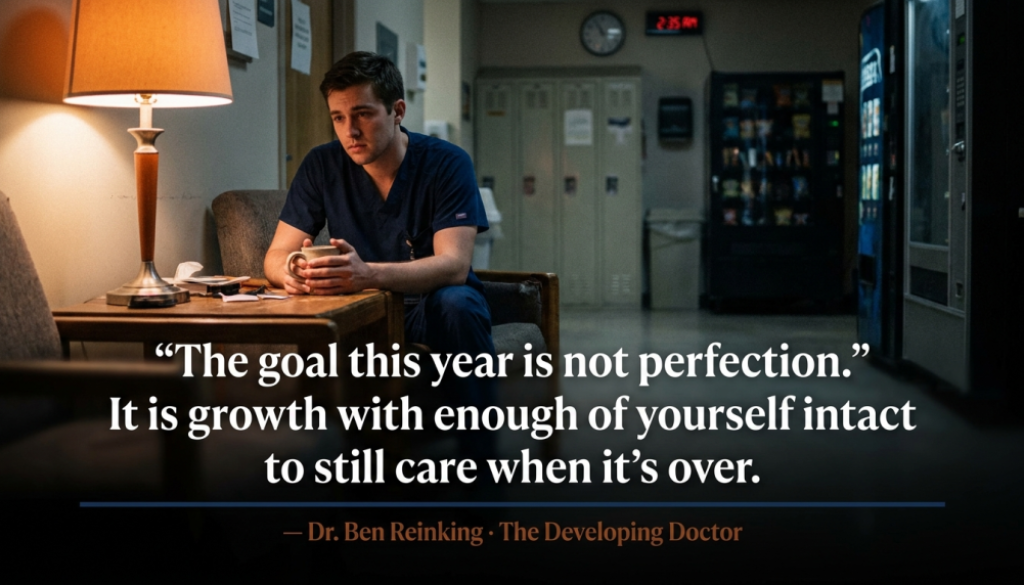
The goal this year is not excellence. The goal is survival with enough of yourself intact to become excellent later.
You will get there. The tie was a good sign — it meant you cared. You are going to need that.
Frequently Asked Questions
When does burnout typically start in residency?
Research shows burnout symptoms can appear within the first month of training. Emotional exhaustion often precedes clinical competence. This is why prevention — building protective habits early — is more effective than attempting recovery after burnout is established.
What is the most important thing a new resident can do to prevent burnout?
Establish one consistent recovery practice in the first week and protect it. The specific practice matters less than its consistency and its psychological separation from work. A walk, a phone call, a meal eaten sitting down — any of these works. What does not work is treating every gap in the schedule as preparation time for the next shift.
Is it normal to feel completely unprepared as a new resident?
Yes — and not just normal but nearly universal. Research on imposter syndrome in medicine shows that the majority of residents experience significant self-doubt in the first months of training. Feeling unprepared does not mean you are unprepared. It means you understand the weight of what you are doing. The residents who never feel unprepared are often the ones who are not paying close enough attention.
How is residency self-care different from what worked in medical school?
Residency self-care is micro-recovery, not macro-restoration. The long weekends, gym routines, and social calendars of medical school are not realistic in intern year. What works instead is small, consistent, protected practices: a five-minute walk, a 20-minute nap, one phone call per week with someone who matters. These are not consolation prizes. They are the right tools for this specific season.
What should a new resident do when they feel out of their depth clinically?
Name it, make your best clinical decision based on available knowledge, and call your senior. Do not wait until you are certain something is wrong — uncertainty is the signal to act. Asking for help is not a sign of inadequacy. It is how medicine works. Every attending in that hospital has made the same call. They respect the resident who reaches out. They worry about the one who doesn’t.
Download the Energy Accounts Self-Audit — a free tool to identify which of your three energy reserves is most depleted and what to do about it.
Ready to build a sustainable career from the start? Schedule a free physician growth consultation with Dr. Ben Reinking.
About the Author
Dr. Ben Reinking is a practicing pediatric cardiologist, certified physician coach, and founder of The Developing Doctor. He completed residency before work hour restrictions existed and learned most of what he knows about burnout prevention the hard way. He now helps physicians at every career stage build the habits, skills, and frameworks that make medicine sustainable for the long run. Learn more at thedevelopingdoctor.com.