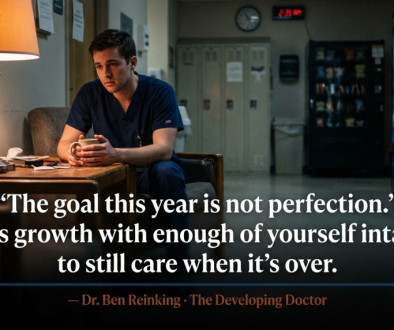

Fulfillment for Physicians: Rediscovering Your Purpose and Your “Why”
“What is the point?” “Will I ever be caught up?” “Is it Friday yet?” “How many years until I can retire?”
How many times did you ask yourself one of these questions this week? Being a physician is one of the most meaningful careers a person can choose. It is also one of the most relentless. There is never enough time, there is always another patient, and it is easy to get so lost in the daily grind that you forget why you chose this path in the first place.
No wonder so many physicians feel unfulfilled or burned out. If this resonates with you, you are not alone, and more importantly, it does not have to stay this way.
The direct answer: Physician fulfillment comes from alignment — when your daily work connects to your core values and your deeper “why.” When that connection breaks down, burnout, cynicism, and disengagement follow. Rebuilding it starts with identifying what you actually value, examining where the gaps are, and making intentional choices to close them.
Why Physicians Lose Their Sense of Purpose
Before exploring how to rediscover your “why,” it helps to understand how purpose gets lost in the first place.
Burnout is a state of emotional, physical, and mental exhaustion caused by prolonged, excessive stress. For physicians, the pressures of RVU targets, endless documentation, shrinking appointment times, and the emotional weight of patient care accumulate over years. The signs are familiar: cynicism, detachment, a sense of diminished effectiveness, and a deepening disconnect from the reason you entered medicine.
But burnout is often not just about being tired. It is frequently about misalignment — a growing gap between what you value and what your work actually demands of you each day. That gap, left unaddressed, grows into the kind of exhaustion that a vacation cannot fix.
What Are Core Values — and Why Do They Matter in Medicine?
Core values are the fundamental beliefs that guide how you make decisions, how you treat people, and what you consider a life well lived. They function as an internal compass — and when your daily work consistently contradicts them, you feel it.
For physicians, core values are often tied to things like patient connection, excellence, teaching, service, or family. The problem is that modern medical practice — with its emphasis on throughput, metrics, and administrative burden — frequently runs directly against those values.
Identifying your core values is essential for three reasons:
- Decision-making: When you know what you value, choices become clearer — whether you are navigating a difficult career decision or simply deciding how to spend your one free evening this week.
- Goal setting: Values-aligned goals are intrinsically motivating. They sustain effort in a way that externally imposed goals rarely do.
- Career satisfaction: When your work reflects what matters most to you, it feels meaningful — even on the hard days.
How to Identify Your Core Values
Start with honest reflection. Set aside 15 uninterrupted minutes and ask yourself:
- What aspects of my life do I protect most fiercely, even when time is scarce?
- What qualities do I most admire in colleagues or mentors?
- When have I felt most alive and engaged in my work — what was present in those moments?
- When have I felt most resentful or depleted — what was missing or being violated?
From your answers, try to identify your top five core values. Write them down. What you name matters less than the act of making them explicit — because what is named can be acted on.
3 Signs Your Values Are Misaligned with Your Work
Misalignment does not always announce itself loudly. It shows up in quieter ways:
1. You feel chronically irritable or detached at work — not just on hard days, but as a baseline. This often signals that something fundamental about your environment is working against your values.
2. You find yourself going through the motions — completing tasks competently but without any sense of meaning or investment. The care is there, but the connection is gone.
3. You have started counting down to retirement — not because you are tired today, but because you cannot imagine a version of this career that feels sustainable long-term.
If any of these resonate, the answer is not necessarily to leave medicine. It is to examine the gap between your values and your current reality — and start closing it intentionally.
Aligning Your Decisions with Your “Why”
Once you have named your core values, use them as a filter for the decisions ahead of you.
Look back first. Reflect on significant career decisions you have made. Did they align with your values? Where they did not — how did that feel? This is not about regret; it is about pattern recognition.
Examine the present. Where is your current work most misaligned with what you value? One concrete example: if you entered medicine out of a deep value of human connection, but 60% of your day is now spent on documentation, you have found your gap.
Plan forward with intention. Ask: what is one realistic change I could make in the next 90 days that would bring my work closer to what I value? It does not have to be dramatic. Redesigning one clinic session, advocating for one policy change, or adding one teaching opportunity can shift the experience of an entire week.
Building Support for the Journey
Reconnecting with purpose is rarely a solo project. Reach out to colleagues who share your values and are willing to talk honestly about fulfillment and burnout. Seek out mentorship — from someone further along the path who has navigated their own version of this. Consider whether physician coaching might accelerate your process by providing structured accountability and a thinking partner outside your institution.
You are more than your profession. You are a person with values, relationships, and a life that extends beyond medicine. Finding the balance — and protecting it — is not a luxury. It is what sustains a long, meaningful career.
If you are ready to stop going through the motions and start building a career that actually fits who you are, coaching can help. Schedule a free 30-minute discovery call with Dr. Ben Reinking — no commitment, just a conversation about what is possible.
Frequently Asked Questions
What does physician fulfillment actually mean? Physician fulfillment is the sense that your work is meaningful, aligned with your values, and sustainable over time. It does not mean every day is easy or rewarding — it means you have a strong enough connection to your “why” to carry you through the hard days without feeling permanently depleted or disengaged.
How do I find my “why” as a physician? Start by reflecting on the moments in your career when you felt most engaged and alive — and contrast them with the moments of deepest depletion. The patterns that emerge point toward your core values. From there, examine your current work environment and identify where those values are honored and where they are undermined. Closing that gap, even incrementally, is where purpose gets rebuilt.
Is physician burnout the same as losing your purpose? They are related but distinct. Burnout is a clinical state of exhaustion, cynicism, and reduced efficacy caused by chronic stress. Loss of purpose is often an underlying driver of burnout — the erosion of the “why” that makes the hard work worth doing. Addressing both requires different interventions: burnout often needs structural relief; loss of purpose requires values clarification and realignment.
Can you regain fulfillment in medicine without leaving clinical practice? Yes — and most physicians want to. The majority of burned-out physicians still love caring for patients; what they have lost is the sense that the system allows them to do it in a way that honors their values. Rebuilding fulfillment often means finding or creating the conditions — within or adjacent to your current role — where your work reconnects to what matters most to you.
How does coaching help physicians find fulfillment? A physician coach helps you do the reflective work more efficiently and with greater accountability than you would alone. Coaches provide structured frameworks for values clarification, help you identify blind spots in how you think about your career, and support you in designing and executing the specific changes that move you toward alignment. It is a partnership built on the premise that you already have most of the answers — you just need the right conditions to find them.
About the Author Dr. Ben Reinking is a practicing pediatric cardiologist, certified physician coach, and founder of The Developing Doctor. With nearly two decades of clinical experience and roles as fellowship director and division director at the University of Iowa, Ben helps physicians at every stage of their career reconnect with purpose, navigate burnout, and build sustainable careers in medicine. Learn more at thedevelopingdoctor.com.