The Developing Doctor’s Operating System: A Physician Framework
The Operating System
I walked into medical school orientation in shorts and a T-shirt.
Everyone else had business casual. I had showed up dressed for the wrong century. At some point that first morning, the facilitator asked us to go around the room and share three words that described us. I don’t remember most of the answers. I remember mine because I hesitated.
My answer: “son, swimmer, student.”
The person next to me said “doctor.” So did the next. So did the one after that. A full quarter of the room had already adopted the identity I had showed up to earn.
I sat there in my T-shirt thinking I don’t belong here. It would be twenty years before I understood that the confident answer wasn’t the right one.
Identity without development is posture. The people who said “doctor” that day were ahead of me on one axis and behind me on another.
I didn’t know that yet. Nobody did. Medical training doesn’t teach development. It teaches performance.
This blog exists because I eventually figured out the difference. And I lost a decade of my career learning it the hard way.
What This Post Is
This is the page I wish had existed when I started medicine. It’s the operating system underneath everything on this site — the framework, the story, and the reason you’re reading.
By the end, you’ll know three things
- How physicians actually develop over a career, and why training doesn’t prepare you for most of it
- The five phases every physician moves through at every inflection point
- Where to start, based on where you are right now
If you’ve ever felt like medicine gave you the skills and left out the manual, this is the manual.
The Story Underneath Everything
I need to tell you three stories before any of this makes sense.
Story One — The Swimming Pool
Before medicine, I was a lifeguard.
Our pool had a rule. Before anyone could go off the high dive, they had to prove they could swim the width of the pool. A reasonable safety measure. One afternoon, two swimmers lined up to demonstrate.
The first was collegiate level, probably Olympic caliber. He stood near the fence line at the edge of the deck, ran across the pool deck, dove in over a couple of other swimmers, and crossed the width in a stroke better than any lifeguard on duty. He was out of the water in under thirty seconds. There was mo question he met the metric with room to spare.
He also broke three rules getting there. Running on the deck. Diving in a zone he shouldn’t have dove in. Jumping over people in the water.
The second swimmer was just learning. He stepped in gently. Looked around to make sure the area was clear. Crossed the width in a jerking, unpolished stroke and was visibly winded by the end. He got out, thanked the lifeguard, and walked to the diving board.
Both swimmers passed. Both demonstrated completely different things.
Competence and professionalism are two separate tracks. You can be technically brilliant and professionally sloppy. You can be technically developing and professionally exemplary.
Medicine assesses one and assumes the other. It doesn’t. That’s why we graduate physicians who look flawless on boards and generate complaints in their first month of attending. It’s also why we overlook developing physicians whose professional instincts are already ahead of the people training them. The pool taught me to look at both tracks. Medicine mostly doesn’t.
Story Two — The Phone Call
During my intern year, I got sick. As a pediatric resident, I commonly caught whatever was going around the school. This time was different. I had a 104-degree fever and hives covering my body. I called my chief resident to tell her I couldn’t come in.
Her first question wasn’t about my health. She asked how busy the clinic was.
I hung up and went to work.
That was the day I learned the real rules of medicine. Be smart. Work hard. Keep your emotions contained. Say yes no matter what the cost. Be tough. Never show weakness. Put the patient first, always — even when “always” means a version of you that no patient would actually want.
I followed those rules perfectly for the next several years. I made full professor and became a fellowship director. I got promoted faster than most of my peers. I also fell apart quietly, at home, in a way I mostly kept hidden. I tried medications, therapy, exercise, and meditation. Nothing moved the needle.
Story Three — The Question
A few years into the quiet collapse, I found my way to a coach who was also a psychiatrist. Early in one of our first sessions, she leaned back and said something I didn’t expect.
“You don’t need therapy. You need coaching. I’m going to put on my coaching hat.”
She let that settle for a second. Then she asked me one question.
“When you walk into work each day, what do you think of?”
I answered honestly. The patient volume. The charting backlog. How much I didn’t want to be there. I told her I was probably grumbling to myself before I crossed the lobby.
She didn’t react much. Just gave me an assignment.
“Before you walk into work each day, I want you to do me a favor. Before you put your hand on the doorknob, think of three things you’re grateful for. That’s where we’re going to start.”
I sighed and rolled my eyes. I’d tried every evidence-based intervention I knew. A gratitude exercise sounded like a wellness pamphlet. I did it anyway, mostly because nothing else had worked and this was low cost.
It was the first step of my recovery.
Mindset matters. Not as a platitude. As a clinical intervention with an evidence base most physicians would respect if they looked at it.
The rebuild started there, with my hand on a doorknob, naming three things before I went in.
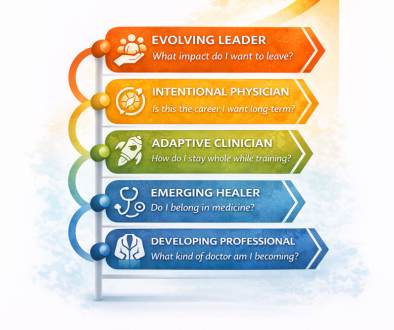
The Developing Doctor Evolution Ladder
Here’s what I didn’t know in medical school. Physicians don’t develop in one direction. You don’t just get more senior. You move through a recurring cycle at every inflection point — residency start, first attending year, first leadership role, mid-career, late-career pivot, every time.
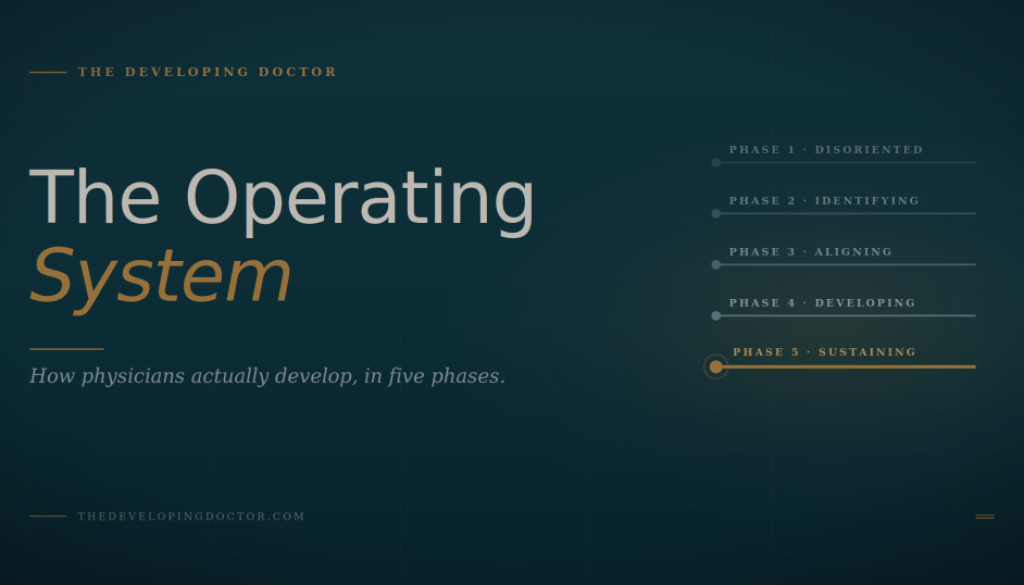
The cycle has five phases. I call it the Evolution Ladder, and I’ve watched every physician I’ve ever coached live through it, usually without names for what was happening.
Disoriented
Something is wrong. You feel it but can’t quite name it. The old strategies aren’t working and you don’t know why. You blame yourself. Maybe you wonder if you’re the problem. Most physicians in Phase 1 are over-functioning while privately drowning.
Identifying
The fog thins. Start putting language to what you’re experiencing. Learn words like burnout, moral injury, values misalignment. Read voraciously. You aren’t ready to change anything yet. You’re ready to name things. Naming is a prerequisite, not a delay.
Aligning
You see what could be different. You experiment and set a boundary. Finally have a hard conversation you’ve been avoiding. Audit your employer’s mission statement against what you actually value. Most of your attempts feel awkward. That’s fine. Alignment is a skill. It gets better.
Developing
You’re building new patterns. Not one experiment — actual habits. You’ve made concrete changes. Maybe you’ve changed your scope. Perhaps you’ve renegotiated your contract. Maybe you’ve reorganized your week around your signature strengths. Phase 4 is where the work gets practical and the results start compounding.
Sustaining — Evolving With Confidence
You’ve reached a new baseline. The work you built in Phase 4 is running on its own. You’re no longer fighting yourself. And you start noticing something unexpected — you’re the person younger physicians ask questions. You’re mentoring. You’re leading. You’ve become the person you needed when you were in Phase 1.
Then something shifts in your career. A new role. A new institution. A family change. A health event. And the cycle starts again, one rung higher than last time.
Most physicians spend their careers bouncing between Phases 1 and 2 without knowing a ladder exists. That isn’t a failure of character. It’s a failure of framework.
You can’t climb a ladder nobody showed you.
The Four Pillars of This Blog
Once you know the Evolution Ladder exists, you can write content for every rung of it. That’s what this blog does. Everything I publish lives in one of four pillars.
Development
The biggest pillar. Identity transitions, imposter syndrome, milestones, the move from trainee to attending, mid-career reckoning, late-career legacy. This is the content nobody else is writing because it requires a framework, not a hot take. If you’re in a transition, start here.
Burnout & Joy
The pillar everyone writes about and most people get wrong. Burnout isn’t a character flaw. It isn’t solved by pizza parties or resilience training. It’s a predictable response to a broken system, and it has specific drivers, specific stages, and specific responses. The joy half matters too. You didn’t come to medicine to be miserable, and the evidence says ordinary joy is the antidote nobody talks about.
Leadership & Mentorship
Communication. DISC. Emotional intelligence. Running a team that respects you. Mentoring trainees who will surpass you. Navigating administrators who don’t share your values. These aren’t soft skills. They’re the skills that determine whether your clinical excellence translates into career longevity.
Career & Coaching
Contracts. Nonclinical paths. Coaching vs therapy vs mentorship. When to stay. When to leave. How to build a career you can respect, one decision at a time. If you’re at an inflection point, this pillar is where the practical work lives.
What This Blog Promises You
Every post earns your time. No filler. No recycled wellness advice. If I don’t have something useful to say, I don’t publish.
I tell you what I actually believe. I’ve been in medicine for over twenty years and made plenty of the mistakes. You get my real answer, not the safe one.
I give you tools you can use today. Not abstractions. Not “reflect on your purpose.” Specific exercises, worksheets, frameworks, and questions that change the next ten minutes of your week.
I treat you like a colleague. You know medicine. Physcians don’t need to be talked down to. You need context, language, and the occasional uncomfortable question nobody else is asking you.
Where to Start
That depends on where you are on the ladder.
Disoriented
Start with the Burnout & Joy hub. You need names for what you’re feeling before you can do anything else. The energy accounts framework and the burnout vs stress post are the two pieces that orient people fastest.
Identifying
The Development hub will give you the most leverage. The imposter syndrome piece and the physician mindset piece explain what medical training programmed into you and what needs to be unlearned.
Aligning
Head to the Career & Coaching hub. This is where the practical work lives — values clarity, contract negotiation, nonclinical paths, when to stay and when to leave.
Developing
The Leadership & Mentorship hub matches where you are. DISC, emotional intelligence, feedback, team dynamics. The content gets harder because the work does.
Sustaining
You probably know where to go already. Read what interests you. Forward pieces to younger colleagues. Consider whether you’d be a good fit for the cohort — not as a participant, but as someone whose presence would elevate the whole room.
The First Tool
If you take one thing from this post, let it be this.
You can’t build a career you respect without knowing what you value. Most physicians haven’t done the values work since medical school, and even then it was performative — written for an admissions committee, not for themselves.
I use a specific tool with every coaching client before we do anything else. It’s called the Physician Values Clarity Worksheet. It takes about twenty minutes. It’s free. And it gives you the scaffolding for every career decision you’ll make from this point forward.
One More Thing
I want to be honest about what this blog isn’t.
It isn’t a wellness program or a substitute for mental health care. It isn’t a replacement for therapy when therapy is what you need. If you’re in a crisis, please call a crisis line. If you’re in a prolonged struggle, please see a professional.
What it is, is the framework and the field guide I wish I’d had when I was sitting in orientation in a T-shirt, listening to everyone else describe themselves as doctors when I couldn’t yet see myself as one.
You don’t have to figure this out alone. You don’t have to burn out first to earn the right to change. Most importantly, you don’t have to choose between being a good doctor and being well — that choice was never real.
Welcome to The Developing Doctor. I’m glad you’re here.
Frequently Asked Questions
Who is The Developing Doctor for?
Primarily for mid-to-late-career physicians at inflection points — burnout, career pivots, leadership transitions, legacy questions. But the frameworks apply at every career stage, and residents and early-career attendings use the content heavily.
Is this a coaching business or a blog?
Both. The blog, YouTube channel, and podcast are free resources. The paid offerings — a self-paced course, a six-week cohort called the Physician Career Architect, and a 1:1 intensive — are there for physicians who want structured support. Most readers never become clients, and that’s the right ratio.
How do I know which phase of the Evolution Ladder I’m in?
Ask yourself what you’re doing. If you’re still blaming yourself for feeling wrong, you’re in Phase 1. Alternatively, if you’re putting language to it, Phase 2. Or. if you’re experimenting with changes, Phase 3. If you’re building new patterns, Phase 4. If you’re teaching others what you’ve built, Phase 5.
What’s the fastest way to get started?
Download the Physician Values Clarity Worksheet, read one post from whichever pillar matches your phase, and subscribe to the email list. That’s a complete first session.