Part 3: Patient-Oriented Approaches – Empowering Individuals and Communities
In this final installment of our three-part series, we shift the spotlight to patients and communities. The American healthcare system spends more than any other country yet delivers underwhelming outcomes: life expectancy lags peers and lifestyle related chronic diseases are the norm. High costs deter many people from seeking care, healthy foods can be hard to find, and neighbourhoods often lack safe places to exercise. These problems are system-driven. The solutions are not easy or perfect. Regardless, continuing on the same path is not an option. Health policy must empower people and communities to enact change that works for them.
If you missed the earlier articles in this series (part 1, part 2), take a moment to read about systemic drivers of burnout and provider-focused solutions in our posts on Physician Burnout, Moral Injury & Ordinary Joy and Physician Leadership & Mentorship. Those pieces set the stage for understanding why patient-centred reforms are essential.
The cost barrier: why access still matters
Despite insurance reforms, many Americans struggle to access and afford care. A recent poll found that 44 percent of U.S. adults report difficulty affording health care, roughly one-third said they skipped or postponed care because of cost, and nearly one in five said their health worsened because of delaying care. These statistics reveal a stark reality: affordability shapes health.
Patient-centred solutions
- Sliding-scale and value-based care models can reduce out-of-pocket costs and focus on preventive services. Medicaid waivers, such as California’s Food Is Medicine initiative, allow social needs like food and housing to be covered within health plans.
- Transparent pricing and simplified billing help patients anticipate expenses.
- Advocacy for enhanced insurance subsidies – for example, extending premium tax credits – ensures that low- and middle-income families maintain coverage and can afford care.
Healthy food access: Food as Medicine and beyond
Access to affordable, nutritious food is fundamental to health. Researchers from Stanford Medicine studied the Recipe4Health produce prescription program, which delivers weekly boxes of fruits and vegetables to low-income patients and pairs them with group health coaching. Participants increased their fruit and vegetable intake by about half a serving per day. More than half of those who attended both the produce deliveries and behavioural coaching sessions reported food security after the program, compared with roughly one-third at baseline. The intervention improved mental health, quality of life and the number of unhealthy days; electronic health records showed improvements in non-HDL cholesterol and a significant drop in HbA1c.
Meanwhile, living in a food desert-being low-income and far from grocery stores-is strongly correlated with higher obesity rates and premature death. Fresh produce has risen in price more sharply than calorie-dense, nutrient-poor foods, leaving low-income communities at a disadvantage. Addressing these inequities requires structural interventions.
Patient-centred solutions
- Produce prescriptions and medically tailored meals: expand programs like Recipe4Health nationwide and make Medicaid waivers permanent.
- Double-up SNAP and farmers market incentives: subsidise fruits and vegetables for SNAP participants to increase affordability.
- Community gardens and urban agriculture: support local growing initiatives that empower residents and create access to fresh food.
- Policy measures: commit to phasing out food deserts through targeted grants that incentivise grocery stores and mobile markets in underserved areas.
Policy levers: sugar-sweetened beverage taxes and preventive screenings
Policy can shape the environment in which individuals make choices. Evidence shows that jurisdictions with sugar-sweetened beverage (SSB) taxes see significant reductions in sugary drink sales and sugar intake, as well as modest improvements in weight, oral health and perinatal outcomes. For example, studies document declines in child obesity and reductions in tooth decay among low-income adults and children following implementation of SSB taxes. Perinatal outcomes also improve, with lower risks of gestational diabetes and fewer infants born small for gestational age.
Another preventive policy lever is screening and early detection. Analyses of claims data reveal that when colon or breast cancers are detected through preventive screening, the majority are found at stage I, whereas cancers detected after symptoms appear are often more advanced. Early detection dramatically reduces treatment costs-for example, breast cancer treatment averages around $83,000 when discovered at stage I but swells to nearly $250,000 at stage IV. Similar differences exist for colon cancer. Ensuring no-cost access to screenings and removing barriers such as transportation and language are essential.
Patient-centred solutions
- Advocate for SSB taxes and reinvest revenues into community health programs such as nutrition education, parks and dental clinics.
- Protect zero-cost preventive services under the Affordable Care Act and expand no-cost screening to include at-home self-collection kits, such as for cervical cancer.
- Implement community screening events with mobile clinics and bilingual staff to reach uninsured and rural populations.
Community health workers and peer support
Community health workers (CHWs) bridge clinical care and community needs, addressing social drivers of health. The Individualized Management for Person-Centered Targets (IMPaCT) CHW model standardises hiring, training and supervision. Evaluations across several sites show that CHW programs can be sustained over multiple years and significantly reduce acute care use. Policy experts note that evidence-based CHW programs improve patient outcomes, reduce costs and are a key strategy for addressing social and structural drivers. CHWs help patients navigate insurance, connect to social services and reinforce treatment plans-especially for people with low health literacy or complex needs.
Peer support and mental health services also empower patients. Peer-led support groups-whether for chronic diseases, parenting or addiction recovery-create safe spaces for individuals to share experiences and build resilience.
Patient-centred solutions
- Scale evidence-based CHW programs across health systems and ensure reimbursement through Medicaid and commercial insurers.
- Employ peer coaches and navigators to assist with chronic disease management, mental health, pregnancy and postpartum care.
- Integrate CHWs into primary care teams to screen for social needs and coordinate referrals.
Digital tools: remote monitoring and telehealth
Digital health empowers patients to manage chronic conditions at home. Qualitative studies of remote patient monitoring (RPM) programs for Medicaid patients with diabetes and hypertension show that participants increase the frequency of self-monitoring, feel more in control of their health, report weight loss and improve blood pressure and blood glucose levels. Patients value text reminders, improved care coordination with providers and the flexibility of virtual visits. Barriers such as lack of insurance coverage and limited access to supplies highlight the need to integrate social support with technology.
Beyond qualitative data, economic analyses suggest that RPM programs can reduce hospital readmissions by nearly 40 percent for patients with chronic conditions. Recent regulatory changes from CMS and the American Medical Association streamline billing for FQHCs and rural health clinics, permanently cover audio-only telehealth and introduce new CPT codes for shorter monitoring periods and digital mental health services. These changes expand access to telehealth and reduce administrative complexity for providers.
Patient-centred solutions
- Deploy RPM for chronic diseases such as hypertension, diabetes and COPD, with special adaptations for those lacking broadband (e.g., phone-based reporting).
- Ensure technology training and health literacy support so patients understand how to use devices and interpret data.
- Couple RPM with wrap-around services-food delivery, mental health care, transportation-to address social needs identified through monitoring.
Health literacy and education
Health literacy or the ability to obtain, understand and use health information, affects everything from medication adherence to chronic disease management. Evidence shows that health literacy interventions improve health-related knowledge, adherence to treatment, patient-provider communication, mental health and patient satisfaction. Interventions combining written and visual materials, multimedia and in-person counseling increase comprehension and appropriate use of health care. Programs tailored to older adults or individuals with limited literacy build capacity to retain and apply information. Diabetes self-management programs incorporating health literacy strategies may reduce HbA1c levels and improve outcomes. Importantly, these interventions have the potential to decrease health disparities because benefits are greater among minorities and low-income populations.
Patient-centred solutions
- Develop plain-language educational materials in multiple languages and formats (written, video, podcasts).
- Implement teach-back and shared decision-making to ensure patients understand their care plans.
- Offer community classes on navigating the health system, including how to use patient portals, evaluate online information and communicate with clinicians.
- Encourage early health literacy education in schools to foster lifelong skills.
Built environment: parks, walking and active communities
Physical activity is a cornerstone of health. Yet access to safe and convenient places to exercise varies widely. Recent research examining wearable data from thousands of participants across dozens of U.S. cities found that park accessibility-not merely the amount of greenery-is the strongest predictor of daily movement. A ten-percent increase in park accessibility corresponds to roughly 107 additional steps per day. The benefits are greatest among non-white residents, older adults and those less active at baseline, suggesting that improved park access can reduce health disparities. The study emphasises that enhancing connectivity-such as pedestrian overpasses, safe walking paths and transit links-to existing parks may be more effective than simply building new parks.
Patient-centred solutions
- Invest in safe walking and biking infrastructure to connect neighbourhoods to parks, schools and grocery stores.
- Ensure equitable park access by prioritising improvements in low-income and racially diverse communities.
- Partner with local governments to design parks with community input, including features like shaded walking paths, playgrounds and exercise equipment.
- Create community walking groups and park-based exercise programs to build social connections and encourage physical activity.
Bringing it all together
Community-centred health at a glance
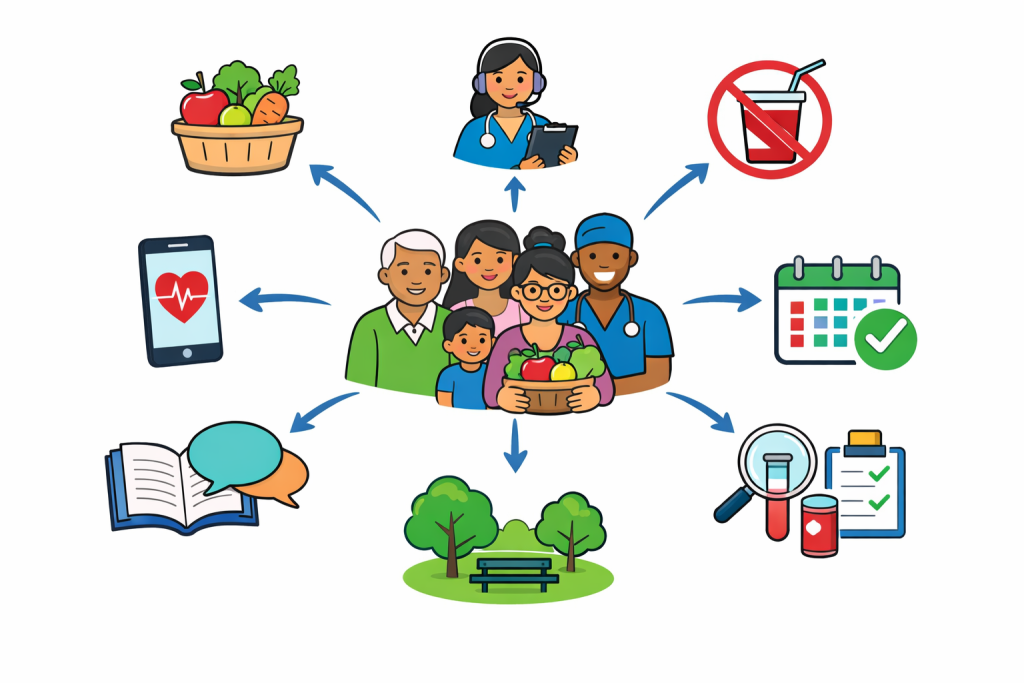
The illustration below captures the pillars of a patient- and community-centred approach. A circle of diverse people represents the community, surrounded by icons for healthy foods, community health workers, digital monitoring, health literacy, accessible green spaces, sugar-sweetened beverage taxes, preventive screenings and personal health checks. Each element connects back to the community, symbolising a supportive ecosystem that empowers individuals to thrive.
Designing patient-centred programs: a practical sequence
When developing new initiatives-such as a chronic disease management program-health systems and policymakers can follow this sequence:
- Understand community needs. Map local barriers to health: access to food, transportation, literacy, safe housing and cultural attitudes. Engage residents through surveys, community meetings and focus groups.
- Co-design solutions with patients. Include patients and caregivers on advisory boards to shape program goals and operations. Tailor interventions to cultural and literacy contexts.
- Integrate social services and medical care. Connect CHWs, nutrition programs, housing assistance and mental health services to clinics. Use telehealth and RPM to extend care into homes.
- Leverage policy and funding. Advocate for SSB taxes, Medicaid waivers for Food as Medicine programs and funds for park accessibility. Align interventions with value-based payment models to ensure sustainability.
- Measure and adapt. Use data on health outcomes, patient satisfaction, engagement and cost savings to iterate. Adjust programs based on feedback and scale successful models across communities.
Conclusion
Empowering patients and communities is essential to reversing America’s declining health. (It is also essential for the health and wellbeing of healthcare providers.) Evidence shows that providing affordable, nutritious food; implementing preventive policies; expanding community health worker programs; adopting digital tools; improving health literacy; enhancing park access; and designing patient-centred initiatives can yield meaningful health benefits. These strategies work best when they are co-created with communities, address social determinants and are supported by policy and funding. By centering the needs of people, we not only enhance individual well-being but also build healthier, more resilient communities and ultimately ease the burden on providers and the health system itself.
References
- Sparks, G., Lopes, L., Montero, A., Presiado, M., & Hamel, L. (2026, January 29). Americans’ challenges with health care costs. KFF. https://www.kff.org/health-costs/americans-challenges-with-health-care-costs/
- Savchuk, K. (2025, March 4). A prescription for produce improves health, new research finds. Stanford Medicine. https://med.stanford.edu/news/insights/2025/03/food-as-medicine-produce-education-chronic-disease.html
- University of Wisconsin Population Health Institute. (2025). Limited access to healthy foods. County Health Rankings & Roadmaps. https://www.countyhealthrankings.org/health-data/community-conditions/health-infrastructure/health-promotion-and-harm-reduction/limited-access-to-healthy-foods
- Moran, A. J., Krieger, J., & Roberto, C. A. (2025). Sweetened beverage taxes reduce sugary drink purchases and improve health (Policy brief). University of Pennsylvania Perelman School of Medicine & University of Washington. https://assets.nationbuilder.com/heatlhyfoodamerica/pages/465/attachments/original/1748442434/Policy_Brief_Bev_Tax_Health_Outcomes_FINAL_May2025.pdf
- Blue Cross Blue Shield Association. (2026, February 3). Preventive screenings lead to better outcomes and reduced spending. https://www.bcbs.com/about-us/association-news/preventive-screenings-improve-outcomes-lower-costs
- Knowles, M., Vasan, A., Pan, Z., Long, J. A., & Kangovi, S. (2025). Scaling an evidence-based community health worker program with fidelity: Results and lessons learned. Milbank Quarterly, 103(2), 416. https://doi.org/10.1111/1468-0009.70011
- Boone, M. (2025, August 7). Emory peer support program helps ease health worker burnout. Emory News Center. https://news.emory.edu/stories/2025/08/hs_peer_program_07-08-2025/story.html
- Dalstrom, M. D., Jordan, S., Klein, C. J., & Cooling, M. (2026). Examining a remote patient monitoring program with Medicaid patients managing diabetes and hypertension: A qualitative study. Journal of Patient Experience. https://doi.org/10.1177/23743735251414380
- Medify Health. (2025). 2025 Outlook: Regulations impacting remote patient monitoring in 2025. https://medifyhealth.com/wp-content/uploads/2025/01/2024-12_Medify_2025-RPM-Regulations.pdf
- University of Wisconsin Population Health Institute. (2025). Health literacy interventions. County Health Rankings & Roadmaps. https://www.countyhealthrankings.org/strategies-and-solutions/what-works-for-health/strategies/health-literacy-interventions
- Lu, Y., Reichert, M., Guerry, A. D., et al. (2025). Wearable data link urban green space to physical activity. Nature Health. https://doi.org/10.1038/s44360-025-00011-y