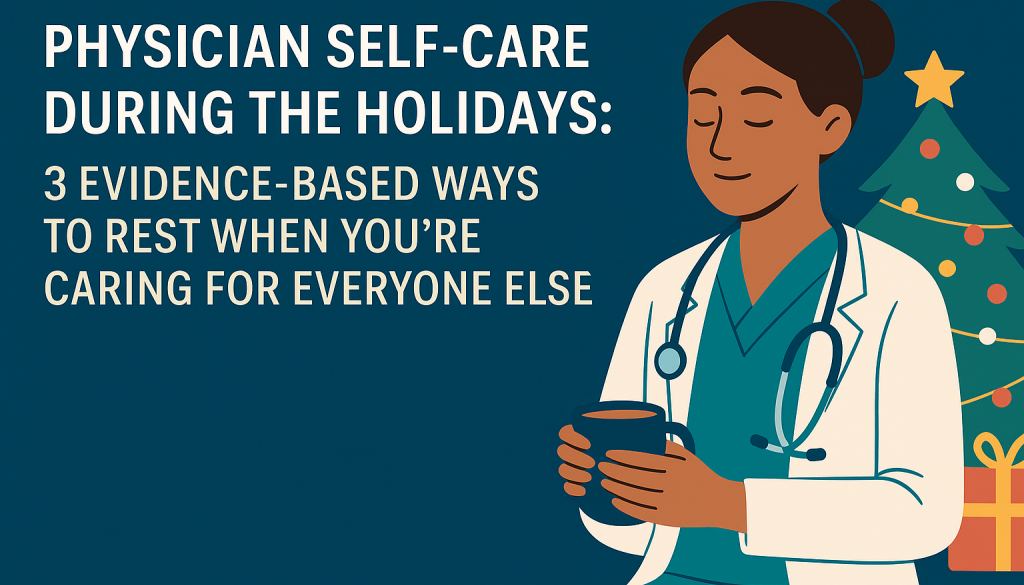
Physician Self-Care During the Holidays: 3 Evidence-Based Ways to Rest When You’re Caring for Everyone Else
It’s December, you’re standing in the kitchen at 9 PM, still in your scrubs, trying to wrap presents while mentally reviewing tomorrow’s patient list. Your partner asks about weekend plans, your phone buzzes with call schedules, and somewhere in the back of your mind, you’re wondering when you last sat down for more than five minutes.
Sound familiar?
Last week, I found myself eating lunch in front of a computer screen, scrolling through gift ideas on my phone while simultaneously charting. That’s when it hit me—I was treating rest like it was optional, like something I’d get to “eventually.” But here’s what I’ve learned after years of December exhaustion: rest isn’t a luxury for physicians. It’s medicine.
The Holiday Paradox for Healthcare Workers
The holiday season promises warmth, connection, and joy. But for those of us in medicine, it often delivers something entirely different: a perfect storm of clinical demands, family expectations, and seasonal obligations that leaves us running on fumes.
Studies back this up. Research shows physicians experience significantly higher stress and lower recovery during the holidays compared to the general population. We’re not just managing our usual patient loads, we’re navigating holiday coverage, increased patient complexity (hello, seasonal depression and family stress), and our own family traditions.
But here’s the good news: meaningful rest doesn’t require a Caribbean vacation or even a full day off. It requires something we’re actually good at: strategic, evidence-based interventions. Just smaller ones, applied to ourselves.
Why Traditional Rest Advice Doesn’t Work for Physicians
Before we dive into what works, let’s acknowledge why self-care advice falls flat for healthcare workers. “Just take a bubble bath” or “sleep when you can” doesn’t cut it when you’re managing 30+ patients, covering holiday shifts, and trying to create magical memories for your family.
We need strategies that:
- Work within our existing schedules
- Don’t require large time blocks
- Actually reset our nervous systems
- Can be implemented immediately
That’s exactly what I’m sharing today. Three evidence-based approaches that have transformed how I navigate the holidays without sacrificing my sanity or my stethoscope.
1. The Science of Micro-Breaks (Your New Secret Weapon)
Here’s something that blew my mind: micro-breaks as short as 60-90 seconds can significantly lower cortisol and improve emotional regulation. I used to think rest had to be substantial to count like a full lunch break or a weekend off. Turns out, I was wrong.
A 2022 meta-analysis found that micro-breaks (30 seconds to 5 minutes) improve:
- Cognitive performance
- Emotional regulation
- Perceived workload
- Overall mood and energy
Why This Works for Our Physician Brains
Micro-breaks interrupt our chronic sympathetic overdrive. That “go, go, go” state we live in the moment our alarms go off to evening charting. Even 60 seconds of intentional breathing shifts us toward parasympathetic recovery and reactivates our prefrontal cortex.
My Personal Micro-Break Revolution
I’ve built two non-negotiable micro-breaks into my day. At lunch, instead of eating at my computer while writing notes, I step away completely. When weather permits, I find a sunny spot outside. Otherwise, I claim a quiet corner by a window.
Mid-afternoon, when my brain feels like mush, I take less than 5 minutes in a quiet spot. I leave my phone at my workstation. No scrolling, no catching up on texts. Just me and my breath.
The result? I’m more focused for my afternoon patients and less likely to snap at my family when I get home.
Micro-Break Ideas That Actually Fit Your Schedule:
- Between patients: 60 seconds of belly breathing before knocking on the next door
- Post-rounds: 2-minute grounding practice before diving into notes
- Parking lot pause: Walk slowly to your car instead of speed-walking while checking messages
- Before bed: One mindful moment with your pet (or plant, or cup of tea)
- Morning coffee: Actually taste it instead of gulping while reviewing the schedule
2. Schedule Your Rest Like You Schedule Procedures
We color-code our patient appointments, block time for procedures, and protect our CME hours. But when it comes to our own restoration? It becomes “whenever I have time”—which in December means approximately never.
Here’s what behavioral science tells us:
- Scheduled rest has 3x better follow-through than spontaneous rest
- Time-blocking reduces decision fatigue (already sky-high for physicians)
- Protected time increases perceived control—crucial for burnout prevention
My Non-Negotiable: Sunday Supper
Every Sunday, whatever family is in town comes to our house for dinner. Sometimes I cook an elaborate spread because I like to cook. Other weeks, it’s takeout on paper plates.
The food doesn’t matter. What matters is that everyone knows Sunday evening is protected. We share stories from our week, laugh about ridiculous moments, and remember why we do what we do. This tradition has become my anchor, especially during the chaos of December.
How to Schedule Rest That Sticks:
- Morning ritual: 15 minutes for coffee and journaling before checking messages
- Partner time: Thursday date night (even if it’s just Netflix on the couch)
- Weekend morning: 2 hours protected for whatever fills your tank
- Evening boundary: Kitchen closes at 8 PM—no more holiday prep after that
- Holiday filter: Before saying yes, ask “Will this energize or deplete me?”
Treat these like patient appointments. They only move for true emergencies.
3. The Phone-Free Family Time Prescription
This one’s tough to swallow, but hear me out. Research shows that even having your phone visible during conversations decreases connection depth and increases cortisol. For physicians who are mentally tracking patient labs, call schedules, and holiday coverage, our phones keep us in perpetual standby mode.
Studies have found:
- Phone presence reduces conversational quality by 40%
- Tech-free family time increases oxytocin (our bonding hormone)
- Evening phone use disrupts sleep architecture—already fragile for physicians
The Unexpected Gift of Presence
Last month, I tried something radical. During my daughter’s school holiday concert, I left my phone in the car. No photos, no videos, no “quick checks” between songs. Instead, I watched her face light up when she spotted me in the crowd. I noticed the kid next to her who kept dropping his jingle bells. I actually heard the music.
That hour of complete presence felt more restorative than my last vacation day.
Practical Phone Boundaries That Work:
- Tech basket: Everyone drops phones in during dinner
- Charging station: Phones charge in the kitchen, not the bedroom
- One fully present event: Choose one holiday gathering for zero phone use
- Evening zone: 7-9 PM is family only—patients can wait
- Weekend morning: First two hours are phone-free
The Mindset Shift: Rest as an Act of Love
Here’s what took me years to understand: rest isn’t selfish. It’s actually one of the most generous things you can do for your patients and family.
When you’re chronically depleted, you’re not bringing your best self to anyone. You’re bringing the exhausted, irritable, checked-out version. Your patients sense it. Your family feels it. And deep down, you know it.
But when you protect small pockets of restoration—even just 60-second breathing breaks—you show up differently. More present with patients. More patient with family. More like the physician and person you want to be.
Making This Work in Real Life
I know what you’re thinking: “This sounds great, but my December is already insane.” I get it. Here’s how to start small:
Week 1: Add one 60-second micro-break to your day
Week 2: Schedule one protected hour for yourself
Week 3: Try one phone-free family meal
Week 4: Evaluate and adjust what worked
Remember, we’re not aiming for perfection. We’re aiming for progress.
Your Holiday Rest Prescription
As physicians, we’re trained to push through exhaustion, to be everything to everyone, to sacrifice ourselves for others. But this December, what if we tried something different?
What if we treated our own rest with the same importance we give our patients’ treatment plans?
Start with one micro-break tomorrow. Schedule one protected hour this week. Put your phone in another room during one family dinner.
These aren’t just rest strategies—they’re acts of rebellion against the culture that tells us physician burnout is inevitable. It’s not. Not if we’re strategic, intentional, and kind to ourselves.
The holidays will still be busy. Patients will still need us. Family will still have expectations. But with these evidence-based strategies, you can navigate it all without losing yourself in the process.
Because here’s the truth: taking care of yourself isn’t separate from taking care of others. It’s the foundation that makes everything else possible.
FAQs About Physician Rest During the Holidays
Q: Do micro-breaks really make a difference when I’m seeing 30+ patients a day?
A: Absolutely. Studies specifically on healthcare workers show that micro-breaks as short as 60 seconds improve focus, reduce errors, and decrease emotional exhaustion. Think of them as mental reset buttons between patients.
Q: How can I rest when I’m on call during the holidays?
A: Being on call doesn’t mean being constantly vigilant. Keep your phone on but face-down. Take micro-breaks between calls. Use scheduled rest during quiet periods. The key is intentionality within constraints.
Q: What if my family doesn’t understand why I need alone time?
A: Frame it as an investment in being more present when you’re with them. Explain that 30 minutes of solitude helps you show up as a better partner/parent/family member for the remaining hours.
Q: Is scheduling rest realistic with unpredictable patient needs?
A: Yes, with flexibility. Schedule rest in windows (e.g., “sometime between 2-4 PM”) rather than rigid times. Protect what you can, adjust when needed, but don’t abandon the practice entirely.
Q: How do I handle guilt about taking breaks when colleagues are also overwhelmed?
A: Remember that modeling healthy boundaries gives others permission to do the same. Your micro-breaks don’t take away from patient care—they enhance your ability to provide it sustainably.